Friday, 14 February 2025

Created by Humans for Humans

Every so often, when our bookshelves are full, and we're faced with a choice between making more space or giving up buying books, I sell the odd few volumes at Ebay. I hadn't done it for a while, and when I went back, at the end of last year, I discovered that the site has a new feature. It lets sellers use AI to create the description of the item they are listing. So, I tried it. I filled in all the basic information—title, author, publisher, condition, special features, all that sort of stuff—so the bot had all of that to work with.

Here's the human-made description I wrote myself:

John Silence by Algernon Blackwood, published by Eveleigh Nash in 1916 (originally published in 1908).

From the library of the distinguished writer of science fiction, fantasy and weird fiction, Donald Wandrei (1908-1987).

Original blue cloth with original dust jacket. Binding firm, endpapers toned, a very small amount of spotting here and there. The dust jacket has a small tear near the spine, a few nicks and chips, and a pink stain at the front bottom edge. An attractive, very good copy.

Please do inspect the photographs as they form part of this description (and they'll give you a much better picture, if you'll pardon the pun, of the book's condition).

Comes from a smoke-free and pet-free home.

All books listed are from my own personal collection. I am selling to create space (to buy more books!). All books have been cared for in a damp-free, smell-free environment. If you would like more photos, I'm happy to take more. Need more details? Just drop me a line; I'm always happy to be of assistance.

And here's the Ebay bot's effort:

This is a hardback book titled "John Silence" by Algernon Blackwood, featuring the occult detective character. 
The hardcover binding and English language make it a valuable addition to any literature collection. The author's unique perspective on the topic of literature and fiction makes it a must-read for any book lover. 
This edition is part of the library of Donald Wandrei.

The book was listed for £270. So, keeping in mind the fact that the bot is supposed to help you sell a rare book—and not a cheap one that you can pick up at any railway bookstall—what do you notice?

  1. It's as dull as dishwater and has no personality.
  2. It includes hardly any of the information it had to work with and absolutely nothing about the book's condition or the date it was published.
  3. It incorrectly states that the 'edition' is part of the Donald Wandrei library.
  4. Look at that bit I've highlighted in red. According to the first part, being a hardcover book in English is enough to make it valuable. According to the second part... Well, say what now?

Using my human-made description, I sold the book within two hours of listing it. The bot's description would most likely have resulted in prospective buyers sending me messages to request information that should have been in the listing to begin with. I'd have ended up writing responses that shouldn't have been necessary, spending more time on doing that than I would have done in producing my own human description to begin with. Or buyers might just have passed the book by, and I'd have lost that sale; after all, if I couldn't be bothered to put in some effort, or didn't have the knowledge to put together a proper description, why should they buy from me?

Of course, not all AI is created equal, and some bots are better than others. But at what? In my experience, some are better than others at producing writing that isn't so dull that it makes you want to pull your own eyes out, but that writing always contains a certain (or possible a large) amount of utter nonsense. As time goes by, they may get better at forming a sentence, but it's looking like the nonsense is here to stay. If we're lucky, they'll end up just like your old Uncle George, who knows everything about quantum mechanics without ever having actually studied the subject; he's so confident, so sure of everything he says, and so capable of boring all and sundry at Christmas parties with what we all know is complete tripe. If we're unlucky, the better AI gets at sounding like it knows what it's talking about, the more difficult it will be for us to separate information from misinformation. Neither outcome is desirable.

The BBC recently undertook research into four AI assistants: OpenAI’s ChatGPT; Microsoft’s Copilot; Google’s Gemini; and Perplexity. They wanted to find out whether these assistants 'provided accurate responses to questions about the news; and if their answers faithfully represented BBC news stories used as sources'. The bots were given access to the BBC website and asked to use BBC stories when putting together answers. The BBC found that: 91% of AI answers had 'some issues'; 51% had 'significant issues' of some form; 19% of AI answers that cited BBC content contained factual errors, including incorrect numbers and dates; 13% of the quotes supposedly taken directly from BBC articles 'were either altered from the original source or not present in the article cited'. 

That bit in red is very important. It is something I've encountered every time I've experimented with an AI bot; they alter what should be a direct quote, they make stuff up, and they attribute information to the wrong person/organisation. And, as the BBC rightly points out, 'inaccuracy and distortion can lead to real harm'. The BBC concluded that 'AI assistants cannot currently be relied upon to provide accurate news and they risk misleading the audience'.

I can't help thinking that, as more and more people cotton on to the fact that AI bots get a lot of things wrong and make stuff up, they'll begin to avoid interacting with AI-produced content. A bot assured me that bots cannot lie, but an unintentional untruth is capable of doing exactly the same damage as an intentional lie. So why rely on AI and risk being misinformed? And if you think people won't be able to tell the difference between AI content and human content as these bots 'improve', I have two answers for you:

  1. Human beings are already becoming familiar with the tone of AI-produced content and will become better able to spot and avoid it as time goes by. They learn and evolve in a way that chatbots simply can't.
  2. If AI bots get better at seeming human, and humans are duped into believing they're reading things created by humans, will that be a good thing, considering their tendency to hallucinate? And no, there's no sign that those hallucinations are going to go away.

Going back to that Ebay bot, my own response to encountering AI-generated descriptions at that site is generally one of the following:

  1. Laugh and move on.
  2. Try to find actual information, get frustrated, then move on.
  3. Assume that the seller doesn't know what they're selling and move on.

You'll notice that bit about moving on. It is so boring to read the same dull, droning nonsense over, and over, and over. No, thank you... I'm outa here!

Bots cannot think, feel, empathise, or care. They cannot reproduce accurate information when it's handed to them on a plate or determine when it is outdated or out of context. They make stuff up. They often produce lots of words while saying very little of substance. In short, they are the world's worst writers, the people who are fired after a week because they bore people, mislead people, and damage company reputations.

The only way to connect with your human audience is to reach out to them with human-produced content. Ultimately, life for us humans is too short for us to be forced to spend a lot of it interacting with unthinking, unfeeling, uncaring machines.

You can read the full BBC findings by clicking here.

Saturday, 27 January 2024

Why Do We Specialise in Writing for the Life Sciences Industry?

In January 2007, I almost died. 

I don't remember which I noticed first, the nausea or the red blotches. Or the heat. It's possible that they all arrived together. I remember feeling extremely lightheaded, and I have a vague recollection of being carried out of the house and bundled into the back of the car by my husband, Ryoma. I remember that my skin puffed up and began to hurt. Then nothing... until I woke up in a bed in the local hospital's Intensive Therapy Unit. For the next few days I was unconscious most of the time. 

I wasn't always sure about where I was. And I hadn't a clue what was wrong with me. Unfortunately, my doctors were equally baffled. Drugs were pumped into me. Tests were run. Bacterial meningitis was considered, then rejected. Septicemia was suggested. An allergic reaction was thought likely, until it wasn't. My heart rate was too fast, my temperature was too high. I couldn't eat, walk, or string enough words together to create a sentence. I may have been out of it most of the time, but I was aware—as was my family—that death wasn't out of the question. Later, when I was back home, Ryoma told me that he'd been informed, when we first arrived at the hospital, that a delay of just a few minutes could have resulted in me not surviving.

The hospital doctors shook their heads and sighed, then decided to throw everything at me; thankfully, eventually something stuck. A week later, the blotches had disappeared, along with the pain I'd been feeling, my heart rate was almost back to normal, and I was eating again. My release was delayed by a stubbornly high temperature, but eventually I was back home. By the time I was released, it was suggested that a virus and subsequent infection had caused the trouble. But the last doctor to speak to me confirmed that she and her colleagues didn't really know what had made me so ill. 'Keep on taking the pills,' she said; 'we don't know which ones worked, so take them all, in case... well, just keep on taking them.'

I was released, but I wasn't what you'd call recovered. Recovery took another eighteen months. When I first returned home, I couldn't walk a few steps without getting out of breath. I slept on and off all day, and I suffered constant headaches. At some point—funnily enough, I can't remember when—it was discovered that I'd lost quite a bit of my memory. 

Eventually, I did get back to 'normal'. Well, that's not strictly true; I never returned to being the me that I had been before my illness. Is it possible to get so up close and personal with Death and remain unchanged? I don't think so. My view of the world, of what matters, and of the direction I wanted to take in life all changed. Once I had recovered sufficiently, Ryoma made the decision to move into working with the Life Sciences Industry; it was his way of giving back.

A lot has happened since then, but one thing has remained the same: I am always grateful for the medicines that saved my life—whichever ones did the trick—and the doctors and nurses who pumped me full of them. We're all just a hop, skip and a jump away from illness or injury, and where would we be without our hospitals, doctors, nurses, researchers, medical device manufacturers,  laboratories, and so on? 

Not so very long ago, we were all oblivious to the future existence of Covid 19, and then... well, you know the rest. Is there a sensible person alive now who isn't more aware of the fragility of human life as a result?

Why the Life Sciences? Well, it's a natural consequence of benefitting from their existence.

Wednesday, 17 January 2024

Book News: The Other End ~ R. Ellis Roberts

I am extremely pleased to announce that on 14 February Nezu Press will release a lovely new hardback edition of The Other End by R. Ellis Roberts. 

In his day, R. Ellis Roberts was a well-known literary critic and writer. He contributed reviews and articles to a number of periodicals, including the Daily News, Observer, Empire Review, London Mercury, Bookman, Saturday Review, and Guardian. He was literary editor for the New Statesman and Time and Tide, and he hosted a book review programme for BBC Radio. In 1923, his only collection of uncanny short stories, The Other End, was published by Cecil Palmer and received glowing reviews. The critic for the Bookman declared the author ‘as well able to write stories of his own as to criticise those of others’, having achieved a mastery of his subject that at times ‘challenges comparison with Poe and Hawthorne’. And Gerald Gould, in the Saturday Review, suggested that no nervous person should read the book when ‘alone at night in a remote cottage on a lonely moor’. This new edition of The Other End includes four reviews written by R. Ellis Roberts about the work of Arthur Machen, of whom he was an admirer—for the Bookman, Daily News, and Sewanee Review—and a biographical essay by Gina R. Collia, ‘R. Ellis Roberts: The Critic Who Read for Pleasure’.

You can pre-order it directly from Nezu Press (Publisher shop: Click here). Or you can do so from the usual online retailers; the book will be showing up in all the usual places soon.

Nezu Press, 14 February 2024.
978-1-7393921-7-8.
Hardback with dust jacket, 258 pages.

Thursday, 16 November 2023

Book News ~ The Master of Hullingham Manor ~ New Edition

I am very pleased to announce that on 29 November Nezu Press will release a new hardback edition of the 'shilling shocker' The Master of Hullingham Manor by Bernard Wentworth, with an 18-page introductory essay by me. I'm always excited about working on a new book, but this one has been particularly exciting for me.

When I first started researching 'Bernard Wentworth', I had only one very small piece of information to work with (and it was a seemingly unreliable one at that)... a mention of her in the gossip column of a Welsh newspaper. But, well, I like a challenge, and I love to research, so I ran with it. What did I find out?... That Bernard Wentworth's history (albeit lacking any murdering), was as shocking and tragic as that of the characters in her book. 

We could call her Mrs Bernard Wentworth... That was one of her aliases... But let's call her by her actual Christian name, Eleanor. Eleanor led an extremely troubled life. She wrote very little, but she put everything she had into what she did write... literally; The Master of Hullingham Manor was born from Eleanor's own experiences of marrying a wrong 'un. She was called 'devious' in court... She was laughed at and persecuted. If you want to know more, you'll have to buy the book!

So, what's the book about? Well, here's the blurb:

Carlos Hullingham is a handsome devil: physically perfect but morally bankrupt. He is society’s darling, ‘but behind the sensuous charm of exterior there lurks the spirit of a fiend, ruthless in its cruelty and malice.’ His first wife, Adelaide Hullingham, is dead… done to death… and now his second wife is proving troublesome.  Originally published in 1897, The Master of Hullingham Manor is a tale of wickedness, murder and revenge. With a cruel aristocrat, an imprisoned wife, a devious asylum owner, a fair bit of adultery, a vaulted room and a ‘Phantom Recital’ to boot. In the introductory essay to this new edition, Gina R. Collia reveals the true identity of Bernard Wentworth and paints a full and vivid picture of the authoress's extremely troubled life. (Publisher shop: Click here)

Nezu Press
978-1-7393921-6-1
Case laminate hardcover, 140 pages.


Thursday, 19 October 2023

Book News: A New Edition of 'The Shadowy Third'

I am very pleased to announce that The Shadowy Third: And Other Stories by Ellen Glasgow, originally published one hundred years ago, in October 1923, is now available in a lovely new centenary edition, and it includes a seventeen-page biographical essay by me entitled 'Ellen Glasgow: The Lone Spirit’.

I wrote a post about the stories in this collection a little while back, and you can read it by clicking here.

You can pre-order it directly from Nezu Press by clicking here. Or you can order it from the usual online retailers (order buttons will begin to appear on sites a few days from now) or from your local bricks-and-mortar bookshop.

Anyway, here's the publisher blurb and all that: 

Ellen Glasgow wrote only thirteen short stories during her long career, seven of which appeared in The Shadowy Third. Published in 1923 by Doubleday, Page & Company, it was the only collection of short stories published during her lifetime. Of the seven tales it contains, only four are supernatural, but all have an eerie quality to them; in fact, ‘Jordan’s End’, a non-ghost story, is the most ghostly story that the author ever wrote. This new edition contains the seven stories included in the first edition and adds to those tales a seventeen-page biographical essay by Gina R. Collia, ‘Ellen Glasgow: The Solitary Spirit’. (Publisher website: Click here)


Nezu Press, 19 October 2023. 
ISBN-13: 978-1-7393921-5-4.  
Hardback with dust jacket, 230 pages.

Wednesday, 30 August 2023

Book News: A New Edition of 'A Seventh Child'

I am very pleased to announce that
 A Seventh Child: A Novel by John Strange Winter (aka Henrietta Eliza Vaughan Stannard), originally published in 1894, is now available in a lovely new edition, and it includes a long biographical essay by me entitled 'John Strange Winter: Author, Wife, Mother & Purveyor of Toilet Preparations’. 

It seemed very fitting that this should be the book I worked on after Through the Night: Tales of Shades and Shadows by Isabella Banks; Henrietta and Isabella were good friends. 

I wrote a post about the stories in this collection back in 2016, and you can read it by clicking here.

You can pre-order it directly from Nezu Press by clicking here. Or you can pre-order it from the usual online retailers or from your local bricks-and-mortar bookshop.

Anyway, here's the publisher blurb and all that: 

Nancy Reynard is the youngest of seven children. She is the seventh child of a seventh child. In fact, as both of her parents are seventh children, she is a seventh child twice over. She is the daughter of Colonel Septimus Reynard and his wife Blanche, and she lives very happily with her family at the Warren in Minchester until she reaches the age of ten, when she discovers that she has the gift of second sight; unfortunately, it is more of a nuisance and inconvenience for poor Nancy. She starts ‘seeing’ things, in particular things about her sister Blanche's new fiancé, and blurting them out for all and sundry to hear, much to his annoyance. And so begins Nancy’s career as a reluctant psychic detective. And now, no liar, thief or murderer is safe when she is near… or thousands of miles away.

Nancy is one of the earliest fictional psychic detectives, and she is unusual in being female and, when her gift makes its first appearance at least, just a child. A Seventh Child was first published in 1894. John Strange Winter was the pen name of the Victorian writer Henrietta Eliza Vaughan Stannard. This new edition includes an introductory essay by Gina R. Collia: 'John Strange Winter: Author, Wife, Mother & Purveyor of Toilet Preparations’.. (Publisher website: Click here)

Nezu Press, 29 September 2023. 
ISBN-13: 978-1-7393921-4-7.  
Hardback with dust jacket, 246 pages.


Wednesday, 19 July 2023

Book News: Through the Night ~ Mrs G. Linnaeus Banks

I am extremely pleased to announce that Through the Night: Tales of Shades and Shadows by Mrs G. Linnæus Banks, originally published in 1882, is now available in a lovely new edition. And this edition includes a long (18 page) introductory essay by me entitled 'Mrs G. Linnæus Banks: The Lancashire Antiquarian'. 

I particularly enjoyed putting this one together. In particular, translating a large amount of old Scots dialogue into English was fascinating and fun. Isabella Banks was an antiquarian—she loved history—and she was so interested in the details of everything. She was also, from the sound of her obituaries and various other things written about her during her lifetime, an extremely nice person.

Anyway, here's the publisher blurb and all that:

First published in 1882, Through the Night: Tales of Shades and Shadows contains fourteen traditional Victorian supernatural stories. There are tales of vengeful ghosts, wraiths, premonitions, voodoo, curses, folklore and fairies. Isabella Banks, best remembered for her novel The Manchester Man, was known for her historical accuracy and meticulous attention to detail, and the appendix from the first edition, which outlines the historical background for the stories, is included in this current edition. Also included in this edition is an introductory essay by Gina R. Collia, 'Mrs G. Linnæus Banks: The Lancashire Antiquarian'. (Nezu Press page: click here)

Nezu Press, 28 August 2023. 
ISBN-13: 978-1-7393921-3-0.  
Hardback with dust jacket, 464 pages.


Tuesday, 13 June 2023

Book News! Mistress Bridget and Other Tales

I am very pleased to announce that Mistress Bridget and Other Tales by E. Yolland, with an introductory essay by me, will be published on 15 July. It contains the novel Mistress Bridget and all seven of the author's extremely rare short stories. But in all likelihood, you've never heard of E. Yolland or the novel/stories, so I am going to tell you a little bit about this project to encourage you to rush off and buy the book.

First of all, who was E. Yolland? Well, until now nobody knew. When I began looking for information, there wasn't a single bit of it out there. There was no clue to the writer’s full name or sex, let alone anything more substantial. So, I started digging about—I went down the rabbit hole I'm always getting stuck in—and what I found out went into writing the fifteen page introduction to this new book. For obvious reasons, I'm not going to tell you a thing about E. Yolland here, but I can tell that this forgotten Victorian author has been fully identified.


So, what about the stories? Well, the novel Mistress Bridget was originally published in 1898 by F. V. White & Co.; it was the author's second book. It is set in seventeenth century England, a country divided in the aftermath of the English Civil War, where paranoia and superstition are rife throughout the land. In the village of Rithycombe in Somerset, Bridget Conyngham, the squire’s beautiful young daughter, is abandoned to the mercy of lawless soldiers and paranoid villagers. Matthew Hopkins, Witchfinder General, is going about the country torturing anyone he doesn’t like the look of, and the villagers of Rithycombe, suspicious of Bridget’s healing abilities, are determined to save Hopkins the trouble of burning their witch. The supernatural element in the novel comes in the form of the ghosts of 'Madam' and a captain of the Parliamentary Army, who both haunt the manor where most of the action takes place.

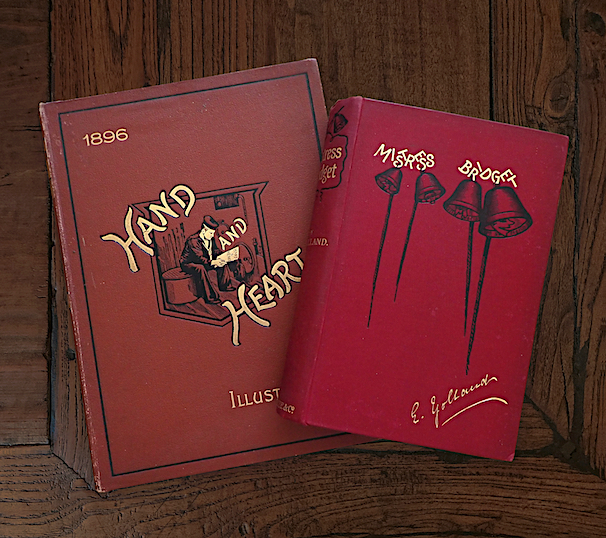
E. Yolland's short stories appeared in two illustrated periodicals: Belgravia and Heart and Hand, the latter being a Church of England penny newspaper. The stories are: ‘The Miser’s Secret’, ‘Only a Smudge!’, ‘Impostors?’, ‘The Secret of the Dead’, ‘Autumn Clouds’, ‘On the Spur of the Moment’, and ‘In the Days of the Cagots’.  Of the seven tales, 'The Miser's Secret', ‘Only a Smudge!’ and 'The Secret of the Dead' have supernatural elements; the latter includes an apparition in an old church:

‘The kneeling lady rose swiftly from beside the coffer, and fell almost prostrate at my feet with thin hands raised in piteous prayer, and heavy tears trickling down the saddest face I ever saw. I rubbed my eyes to clear my vision, and with a start jumped up from what I suppose you will call a doze. I think otherwise, but that matters not.’

When I began my research, I had nothing to go on. I was determined but not terribly hopeful; after all, E. Yolland had been dead more than a hundred years, and even contemporary readers didn't know who the author was. As it is, I am extremely excited to have discovered so much, and I'm even more excited to be able to share my findings. 

Finally, here are the details of the book:

Published: Nezu Press, 15 July 2023.
ISBN-13: 978-1-7393921-2-3
.
Hardback with dust jacket, 314 pages.
Price: £25.00

Pre-order links will be posted here as they become available:


Top: The full dust jacket to the new Nezu Press book.
Bottom: The first edition of Mistress Bridget, 1898, and the 1896 volume of Hand and Heart (in which the short story ‘On the Spur of the Moment’ was published).

Wednesday, 10 May 2023

Book News! The Devil Snar'd ~ George R. Preedy

I'm very pleased to announce that The Devil Snar'd by George R. Preedy, the author best known as Marjorie Bowen, is available in a new edition, and it includes a long introduction written by me. It was originally published as a small paperback ‘ninepenny novel’ by Ernest Benn Ltd. in June 1932. It appeared again a year later, this time published by Cassell, in Dr. Chaos and The Devil Snar’d. But it's been out of print and largely forgotten since then, which is a terrible shame as it's a superbly unsettling story.

Nezu Press, 1 April 2023. 
ISBN-13: 978-1-7393921-1-6.  
Case laminate hardback, 164 pp.

Here's the publisher blurb:

George R. Preedy is one of the pen names of Margaret Gabrielle Vere Campbell, the writer best known as Marjorie Bowen. First published in 1932, The Devil Snar’d is an eerie tale of supernatural influence; it was described by the Daily Herald as a ‘ghost story fit to stand beside The Turn of the Screw.’ Grace Fielding and her unfaithful husband, Philip, have taken Medlar's Farm, in a remote spot in Northumberland, to get away from London and repair their broken marriage. Philip, a well-known author, intends to use the dark history of Medlar’s Farm—a tale of adultery, jealousy and murder—to write his next book, but Grace, already unwell due to the strain caused by her husband's affair, begins to see parallels between her own story and that of the murdered woman, who she believes is guiding her actions. As Philip works on his manuscript, his behaviour becomes more and more suspicious, and as Grace’s mental state deteriorates, a tale of adultery and marital discord soon becomes one of jealousy, obsession and murderous revenge. This edition includes an introduction by Gina R. Collia: 'The Many Masks of Margaret Campbell'.


Above: the new edition alongside the 1932 first edition.

Tuesday, 2 May 2023

As a Matter of Fact, Research Matters to Everyone


Research isn’t just for academics. It isn’t something that’s only relevant to students, professors, writers and scientists. It informs choices we all make in our normal everyday lives, whether we realise it or not. Research enables us to make evidence-based decisions, and, whether we are professionals, stay-at-home parents, students or simply very curious, we all carry out research on a daily basis.

But these days, there is so much information available to us, especially online, and not all of it is accurate, up-to-date or written with our best interests at heart. There’s a lot of misinformation, stale information and simple nonsense out there, and sifting through it all can be time consuming and frustrating.

It might be tempting, when putting together information for a blog post, press release or brochure, to simply include any information that you’ve seen repeated online several times already; after all, if it was in the Guardian, on a well-known supplier’s website, and quoted by a hundred other people who seem to know what they’re talking about, it must be accurate, right?

Working on that line, how many times does information have to be repeated before it’s accepted as a ‘fact’? There is no magic number! Information is factual simply because it is; it has nothing to do with how many times it’s reported in a newspaper, or talked about at a conference, or passed on from your great aunt Maud.

There is no safety in numbers. Nonsense doesn’t become sensible because a hundred people repeated it. There is never any replacement for good, honest research.

I carry out research every day for my work at Word Ferret, and countless times during each of those days I encounter the same thing: identical/very similar statements made on multiple websites with no supporting evidence whatsoever. Mr A copied Mrs B, who copied C & co., who got some information from D & E Ltd., and so it goes on. If nobody has included a reference to the primary source, it’s often difficult to find out where a piece of information originated. Then add in all the problems caused by misquotes, clumsy rewording, simple typing errors and deliberately misleading interpretations of an earlier version of whatever was said or written, and you have a recipe for disaster.

Here are a few things to consider if you’re thinking of putting information out there without getting your facts straight first:

  • Customers/readers may not be quite as willing to swallow nonsense as companies/writers are to inflict it upon them.
  • You may pass on someone else’s misinformation in error, but it is still misinformation, and you’re still responsible for passing it on.
  • Sameness won’t make you stand out. Repeating the same thing that every man and his dog has already said or written will result in you becoming one small voice in a large (potentially misinformed) crowd.

If you want to stand out from the crowd, you have to step out of it. Do the research, or hire someone to do it for you, and present it in a manner that enables your customers/audience to verify at least some of what you’re claiming.

If you need factual, well-researched content, Word Ferret is always here to help.

Friday, 28 April 2023

Book News! The Room Opposite ~ F. M. Mayor

I am very pleased to announce that The Room Opposite: And Other Tales of Mystery and Imagination by Flora Macdonald Mayor, originally published in 1935, never republished and out of print for numerous decades, is now available in a new edition. And this edition has a long essay about the author, written by me. It also includes a long article that Flora wrote in 1905 about life with a touring theatre company. I'm biased, but I think the book turned out really well. I do hope that Flora would be pleased!

Nezu Press, 1 April 2023. 
ISBN-13: 978-1739392109.  
Hardback with dust jacket, 406 pages. 

I wrote a post about the stories in this collection back in 2016, and you can read it by clicking here.

Here's the publisher blurb:

In 1935, Longmans, Green and Co. Ltd. published The Room Opposite: And Other Tales of Mystery and Imagination by F. M. Mayor, a collection of sixteen tales that had been left unpublished at the author's death. It was issued with a recommendation from no less eminent a critic of ghost stories than M. R. James, who wrote, 'The stories in this volume which introduce the supernatural commend themselves to me very strongly.' Secondhand copies of the first edition are incredibly hard to come by, and the book has never been republished... until now. This new edition contains all sixteen stories, along with a long article which originally appeared in The Queen newspaper in 1905 entitled 'Life in a Touring Company'. This edition also includes an introduction by Gina R. Collia: 'F. M. Mayor: Author, Actress & Champion of the Superfluous Woman'.


The new edition alongside the 1935 first edition.

Friday, 24 March 2023

New Sample: Are You Ready for EU GMP Annex 1?

'It’s Almost Here: August 25th, 2023 - Are You Ready for EU GMP Annex 1?'

An article concerning EU GMP Annex 1 “Manufacture of Sterile Medicinal Products” and the approaching deadline for compliance. Written for PNR Pharma.

You can download the PDF by clicking on the PNR logo on the right.

Friday, 3 March 2023

Choosing an Editor - It’s Not a One-Size-Fits-All Kinda Thing

There are a number of things to consider when choosing an editor, and I'll go through a few of them here, but the thing to remember is that all editors are different, just as all writers and manuscripts are different. Whilst you should be looking for a professional with the right credentials or background, you also need to find one that you can work with. After all, if you can't tolerate the briefest exchange with a person and don't trust a word that comes out of their mouth (or pen), you're not likely to create a written masterpiece with them, no matter how many qualifications and recommendations they have under their belt. So, while you're checking their social media profiles, consider whether or not you're going to like them enough to work with them. Consider whether or not they're likely to be the right fit for you. 

And remember, you're not buying a take-out pizza from them; it's not a ten-minute wait, two-minute exchange, instant gratification kind of transaction. You're starting a journey with them. If you don't travel well together, the journey will be an uncomfortable one; in fact, you may never reach your destination. So, keep this in mind when you're perusing each editor's wares.

Look for an Editor Who Works on Books Like Yours

There's no point in finding the most accomplished editor who ever existed, then sending off your science fiction novel, only to receive a response informing you that Mr Such-and-Such only edits cookery books. Look for an editor who works with your kind of book. Better still, find one who reads your kind of book too. It might sound odd, but not all editors read a lot (just as - and this is a fact that never ceases to amaze me - not all writers read a lot). If you have a horror novel that needs editing, look for an editor who reads the right kind of horror novels. Find out if they have a Goodreads profile, then go through their bookshelves. Check their social media accounts to see if they discuss their reading habits. Bookish people tend to post online about bookish things. Take me, for example; I'm all over the Internet... a veritable open book.

Look for Relevant Experience

Experience is good, but it has to be relevant. When an editor tells you they've enjoyed thirty years in the business, dig a little. 'Did you always edit romance novels?' you ask them. 'Well, in all honesty, no. I began doing that last Tuesday,' they reply. 'I used to edit books about gardening, and before that I worked for a scientific journal.' In the same way that no writer can write every kind of book, no editor can edit every kind. 

Understand Your Own Requirements

Familiarise yourself with the various types of editing and choose the one that's right for you. You may need a proofreader to go through a finished manuscript to check for typos and punctuation errors just prior to publication. Alternatively, you may need a developmental editor to help with the plot, character development, dialogue, and to check for consistency. Some editors offer one service, while others offer multiple services, and it's best to make sure you understand exactly what is included in the service you choose before going ahead. 

Some editors are more expensive than others, and the amount you pay will depend on the specific project; work within your budget. If hiring the editor you like most will leave you destitute, keep on looking until you find one you can afford. And some editors are booked up for months in advance. There's no point hiring an editor who can't begin work on your project for six months if you need it to be completed in a fortnight. Be honest and realistic about your requirements and expectations from the outset, and make sure that you and your editor are on the same page before commencing work.

Ask for a Sample

Most editors will offer a sample of their work to help you evaluate whether or not they are the right fit for you. Some may suggest sending you a sample from a previous editing job. The better option would be for them to produce a sample edit of your work: you send them a page or two from your project, and they edit it and return it to you. That way, you'll be able to gauge whether or not you like their editing style. Do their comments make you want to grab your pen (or laptop) and get right down to work on revisions without delay, or do they make you feel like rushing off to hide in a cupboard until you're ninety? If it's the latter, go back to your editor list and try out the next one on it.

Without wishing to make the process sound too mysterious, and beyond the understanding of all but the odd mystic who lives atop a snow-covered mountain, there is a certain, indefinable something that exists between a writer and editor when the mix is just right. You'll feel it in your bones (or your water) when you meet the right editor, as will he or she. They will get what you're trying to achieve, and you will recognise that fact.

One last thing before I go. The editing process can be a lengthy one - it depends on the project and how far you've already gone with it - and it can involve a lot of work, but it should also be an extremely rewarding experience. So, what are you waiting for. Go out there and find yourself an editor!

Wednesday, 1 March 2023

Would I Lie to You? - ChatGPT's Tenuous Relationship with Facts

After writing my last post about ChatGPT, I vowed to myself that I would never use it again. Today, I broke my vow. 'Oh, Gina, why did you do it?' I hear you cry. Well, in my defence, it's in my nature as a researcher to keep on tugging at a loose bit of string until whatever it's part of unravels; that's how I get to the bottom of things. Unfortunately, when dealing with ChatGPT, it's also a good way to lose your mind.


When you have a chat with the bot, a record of the conversation is stored. You can go back and continue the dialogue at any time. Today, rather than starting from scratch, I picked up where I left off. If you're just joining us and don't know what I'm talking about, you can read all about my earlier encounter with the bot in my post ChatGPT Is Set to Get a Heck of a Lot More Stupid. Alternatively, here's a quick recap: the bot gave me a quote by Jack Hillier, claimed it came from a specific book ('Utamaro: Prints and Drawings'), then suggested it didn't come from any book, warned that the quote was most likely fabricated, admitted that it came from a previous user (who'd found it in an online forum), and finally agreed that the book it originally cited never existed.

Anyway, given that the bot is a slippery customer with a penchant for making stuff up, I began to wonder if the 'previous user' story was even remotely true. So, off I went, back into the abyss. I wouldn't normally simply paste the entire dialogue here, but there's no better way to demonstrate the nonsensical nature of the bot's responses. It's important to remember that, at the point where my conversation with ChatGPT was paused (and I wrote my last post about my experiences), it had been established (and the bot had accepted) that:

The quotation cited by the bot was probably fabricated.
The cited quotation was not contained in any book.
The cited quotation was given to the bot by a previous user (who'd found it in an online forum).
The cited book 'Utamaro: Prints and Drawings' by Jack Hillier does not exist

With all of that as a starting point, I returned to the conversation today, and this is what ensued:


If you come away from reading that without reaching the conclusion that the bot spews fictitious nonsense, I suggest you get yourself off to a brain specialist at speed to have that fluff between your ears tested. 

It's bad enough that it can't generate a halfway accurate response from whatever data it's been trained on previously. But it's also incapable of providing an accurate response using information that it's already generated and received within an active chat session. Trying to get consistent, accurate responses out of the bot is like trying to get the truth out of a compulsive liar; it's an exercise in futility.

That said, I did persevere for a while. The bot had repeated several times that the quote came from a previous user, but was that even a possibility? I mean, the bot had to know its own programming and capabilities, so asking about that was bound to get me a straight answer, right? Nope. I asked if it was possible for the bot to access a quotation given by a previous user and repeat it in an answer to a future user's question. I received seven different answers: 

So, it can't retain or access information from previous user interactions, but it can, and it can't access a specific quotation given by a previous user, but it can, and it can't pass a quotation from a previous user to a future one, but it can, in which case, well... I'm not really sure where that leaves us. 

I can't help but conclude that ChatGPT was programmed to mimic a competent, accurate, credible writer or source rather than to be one. If the goal is to impress rather than inform - and it's not hard to imagine why its developers would be more concerned with the former - it would explain the bot's penchant for padding a poor response - for attempting to 'polish a turd', as they say. In its initial response to your question or command, it will produce a few respectable (if uninspiring) paragraphs for you to gawp at in awe. But, as accuracy and reliability don't appear to feature in what's 'impressive', any factual elements will most likely be utter tosh. As it reminded me several times, it checks nothing and is dependent on the calibre of the information fed to it. Well, they do say that we are what we eat.

If you ask, the bot will state that it cannot lie; it has no personal intent, so it cannot intend to deceive. However, when I asked it to explain further, it did confirm that, whilst it is 'not capable of lying in the same way that humans are', it can 'generate responses that are not true or accurate if [it is] programmed or trained to do so', and that its 'responses may sometimes include linguistic patterns that could be considered persuasive'. If there were to be such a thing as a dishonest human being who, with access to this or some other comparable AI bot, wanted to spread credible-sounding lies at high speed... Well, I'll leave that one with you to contemplate.

Thursday, 23 February 2023

ChatGPT Is Set to Get a Heck of a Lot More Stupid

If you read my previous post about ChatGPT, you’ll know that I tried it out and wasn’t at all impressed. In response to my questions, it repeatedly churned out incorrect information, then, after I insisted that it cite its sources, referred me to an author who never existed. 

Perhaps I am a sucker for punishment, but I went back in today. This time, I approached things from a different angle. Instead of asking a general question about the imprisonment of the Japanese artist Kitagawa Utamaro (which is what I did last time), I asked about the opinion of a particular expert on the subject:


Sounds reasonable, right? Well, whilst I can't claim the ability to recall every word the late (and very sorely missed) Jack Hillier ever wrote on the subject, he was my mentor, I have read his books too many times to count, and I am pretty familiar with his opinions. I knew that the bot's response was incorrect. I asked it to confirm that the quote was by Hillier; it did so. It confirmed that it was a direct quote, and it repeated the title of the book, its publication date and the page where the quote was located. There was a bit of going back and forth, then I challenged it, and I received this response:

In my quest to understand how ChatGPT comes up with this tripe, I prepared to go back down the rabbit hole and into the dreamlike, nonsensical world that it inhabits. Initial attempts to get it to tell me where the 'information' it spouted came from failed completely. For a bot designed to answer questions, it does a good job of avoiding doing so. It can't know everything, it informed me, and searching the Internet to find out where the quote came from is, according to the bot itself, beyond its capabilities. Perhaps I should have offered to google it?

Anyway, the quote had to have come from somewhere; it didn't just manifest out of thin air (okay, we're talking ChatGPT here, so it might have done). So, I persevered:


In no time at all, the bot managed to go from presenting information to me as a fact (several times) to suggesting said information could have been invented. Yes indeed, I have to give it its due; it certainly is fast. It can create nonsense a lot faster than I can. 

As the dialogue continued, I felt very much that I was being sent around in circles (which is what happened last time). And the bot's repeated form responses about its programming and algorithms went no way in explaining why it wasn't able to tell me where the quote came from. But I continued (at great risk to my sanity), and eventually the bot explained that its error was due to 'a misinterpretation of the information provided' to it. 

It was a straw, and I clutched at it. If there was information provided, there had to be an information provider. And, after some probing, the bot revealed the source of its wisdom: a previous user.

They read it in an online forum, no less! Well, fan my brow. Now I can see why writers are so worried that ChatGPT will steal all our jobs. With its incredibly impressive ability to pass on misinformation heard in an online forum - or whispered into its ear by Aunt Maud - it will be utterly unstoppable.

To finish off, I informed the bot of something I'd known all along:


As I said in my last post about ChatGPT, there's enough misinformation out there already; we don't need more of the stuff. I keep on hearing about how the bot will just get smarter and smarter as it learns and adapts. Well, until we humans start posting information in online forums that's considerably more factually accurate, ChatGPT is set to get a heck of a lot more stupid. 

Wednesday, 22 February 2023

Word Ferret & Environmental Sustainability

Last week, I talked about what you can do to live more sustainably. This week, I’m going to talk about what we at Word Ferret are doing to help the planet and fight the climate and nature emergency.

Environmental sustainability is immensely important to us. We are passionate about taking care of our planet and do everything we can to make a positive impact on the world. A lot of companies make similar claims while doing very little to back them up - greenwashing words are cheap -  so what do I mean by ‘do everything we can’?


At Work

To begin with, we make every effort possible to reduce our carbon footprint, rather than offset it after the damage has been done. ¹

Our power is supplied by Octopus, which gives us 100% renewable electricity. Our broadband and telephone provider, Zen Internet, is a certified B Corporation. Also, Zen only operates in the UK, and it doesn’t have any subsidiaries in tax havens.

All of Word Ferret's proofreading, copy editing, copywriting and indexing work - in fact, everything we do - is carried out remotely. There are no car journeys, no flights, and we have no need to use taxis, car rentals, trains or hotels.

We recycle as much as can be recycled. And we don’t replace electronic equipment unless we absolutely have to. Our laptops are MacBook Pros from 2011, and we’ll go on using them until they go to the Great Laptop Heaven in the Sky. We approach the replacement of mobile ‘phones in the same way. We buy only what is absolutely necessary for the performance of our work.

On a Personal Level

Wherever possible, we buy locally sourced food and other products. We always choose the organic option, and we’ve been vegetarians since time began (we also switched to oat-based dairy products, such as milk and ice cream, many moons ago). We switched to solid soap/shampoo years ago (also organic and in paper/card packing), so there are no nasty plastic bottles involved. We look for products that are environmentally friendly, made from recycled materials and that are recyclable themselves. Also, we make every effort to reduce our water usage, and we save a minimum of 600 litres per month by recycling 'grey water'.

We garden organically. We use no nasty chemicals that harm our lovely pollinators, and we always aim to create an environment that attracts them to our garden, along with birds, toads, and other little critters. We have a moderate amount of outdoor space here, but we have managed to plant twenty-seven trees so far. When we moved to our current location, a small area had been concreted over to provide parking for one car; this, of course, is bad for the local wildlife, and rain runs off it more quickly and soaks in less (especially problematic when you’re located on a hill). So, those trees are our attempt to make up for that small section of lost land; the birds love them, and, along with numerous rose bushes, they drink up rainwater like it’s going out of fashion. Many of them also provide fruit.

We buy antiques and secondhand items for our home environment, and, as with our electronics, we don’t replace household things unless they fall apart. Of course, antique and vintage things don’t tend to do that; things used to be built to last.

We also support local charities, food banks and small businesses with donations that can be sold or given to those in need. If we buy too much food, we pass on the surplus. If we have too many books, they are given to friends, local charities or schools. We aim for as little waste as possible.

As I said above, we do not travel to carry out our work duties. In our personal lives, we use a car as little as possible (and we never fly now). We walk all over the place and much prefer using our legs to a set of wheels. In addition to helping the environment, this gives us a chance to actually look at and appreciate it. And when we go out walking, we make sure we bring our litter home.

We use social media to inform others about the climate crisis. We also use it to make others aware of corporate greenwashing, of government failures in tackling the climate crisis, and of products and companies that damage the environment. We make every effort to remain informed so that we are better able to do our part in protecting our planet.

Each and every day, we look for more ways to make a difference, no matter how small, because every little bit helps.

____________________

Note

¹ There’s some interesting information here about the potential problems of carbon offsetting: https://friendsoftheearth.uk/climate/does-carbon-offsetting-work

Friday, 17 February 2023

Sling Your Knickers on the Compost Heap; or, Easy Ways to Live More Sustainably

We make choices every day that effect the environment, the climate and other species that share both with us. From choosing what we eat for lunch to what we eat it with, how we dispose of it and what we wear while eating it, we are making decisions routinely that have the potential to help or damage the planet that supports our very existence. Here are ten things you can do to make a positive impact on the planet and fight the climate and nature emergency.

1. Recycle, Reuse, Resell, Donate and Compost

Living a less consumerist lifestyle can help reduce your carbon footprint. Buy antique, vintage or secondhand rather than brand new. By avoiding buying brand new items, you’ll be helping to reduce the number that are manufactured; you’ll also be reducing the number that eventually need to be thrown away. Generally speaking, antique and vintage items for the home were built to last, and they’re more likely to be unique, so they’re likely to outlast anything you find in a modern department store.

When you are about to throw something away, consider repairing, upcycling or repurposing it instead. Alternatively, if you really don’t want to keep an item but it could still be put to good use, sell or donate it. One man’s junk is another man’s treasure.

Start a compost heap in your garden for food waste. Aside from taking all of those potato peelings and grass cuttings, your compost heap will consume your threadbare clothing if it’s made from a biodegradable source, including your knickers and socks. If there’s still a bit of life in your drawers, you can donate them to charity. Otherwise, remove any component that is not compostable (such as elastic), shred what remains, then add those shreds to your heap. A couple of years from now, your bloomers could be keeping your roses blooming.


2. Think Twice Before Buying

‘Make Do and Mend’ was a pamphlet issued during the Second World War by the British Ministry of Information. It provided useful tips to housewives on how to be frugal but stylish during times of rationing. If you’re serious about helping the environment, make do and mend is something you should be making a return to now.

Every single day of the week, and practically every moment that you’re awake throughout those days, you’re being bombarded with advertisements that are trying to sell you something. But how much of what you buy do you actually need? Do you need a new ‘phone every six months? Your current laptop works perfectly well, so do you really need to buy a new one? Do you really not have a single thing to wear? By buying what you need, rather than buying what you want/are told you want, you’ll reduce your carbon footprint and your shopping bills at the same time.

Shop your own wardrobe when you’re looking for something to wear; change the way you put an outfit together, rediscover accessories you forgot you owned, and give the online clothes shopping a miss. Our grandparents were advised during the war to unpick old jumpers and re-knit new ones. I remember my grandmother doing this when she taught me how to knit, and it was great fun for me as a child, pulling apart my grandfather’s jumpers and unravelling the curly lengths of coloured wool. Instead of throwing out clothes the moment that they suffer some slight damage, learn to sew and knit so that you can repair them. 

Rather than paying a visit to Habitat or Ikea, rearrange the items you already possess when you’re tired of your home environment and feel like a change. Redecorate pieces of furniture that are still sound but have seen better days. Add a new fabric seat or cushion here, a lick of paint there, and create a new interior by giving old things a new lease of life.

If you need a ladder for an afternoon’s climbing but you’re not likely to need one again for another year, hire or borrow it. The same goes for power tools, gardening equipment and anything else that you seldom use. Aside from reducing your carbon footprint, you’ll be accumulating less junk that needs to be stored.

3. Shop Locally

When you buy from large chains, produce is often transported across the country, or across the world, to reach you, creating a great deal of pollution and damaging the environment in the process. When you shop locally and buy local produce, the goods have a much shorter distance to travel, which cuts down on carbon emissions and air pollution. Also, when it comes to fresh produce, a shorter journey means less wastage. It also means less packaging; the greater the distance the produce has to travel, the more packaging it requires to prevent it from getting damaged.

There are other benefits too. Buying from local sellers/producers means you’ll have access to the freshest produce available. You’ll be supporting local businesses and local jobs and boosting the local economy. And these benefits don’t just apply to food; goods made locally are more likely to be unique, of better quality and designed to last longer than mass-produced items from large stores.

4. Eat Sustainably

Farming animals for meat and dairy products ‘creates vastly more carbon dioxide than plants such as vegetables, grains and legumes.’¹ Also, due to the expansion of agricultural land for animal feed production, it is one of the biggest causes of forest loss.² Switching to a plant-based, organic diet will reduce your impact on the environment. Also, reducing your meat and dairy intake, or switching to a vegetarian or vegan diet, will reduce your food bills.

In addition to moving over to a more plant-based diet, you can eat seasonally, cook in bulk and freeze leftovers. You can also try growing your own food in your garden or on an allotment. Every time you waste food, you waste the resources that went into producing it; plan your meals, be smart about your shopping and find ways to use up everything you buy.

5. Be Water Wise

Water is a precious resource, and we should use it wisely to reduce environmental damage. There are a few simple things you can do to keep your water usage in check. Keep an eye on your plumbing and fix any leaks straight away. According to Thames Water, a trickling leak in your toilet can waste up to 200 litres of water each day.³ Don’t overfill your kettle (boiling a full kettle to get one cup of water wastes energy). Resist the urge to wash a single shirt in the washing machine (this wastes both energy and water); wait until your washing machine is full before beginning a wash cycle. Outdoors, install a water butt to catch rainwater for your garden. During times of drought, you can use bathwater or washing-up water, known as ‘grey water’, to water your garden, as long as you use ecological cleaning products (which you should be doing anyway). For some useful information about using grey water, click here.

6. Boycott Businesses and Products that Damage the Environment

Consumer activism plays an increasingly important role in social change. Boycotts that receive national media attention ‘have about a one-in-four success rate in influencing corporate practices,’ ⁴ and, according to the study The Rise of Sustainable Media, prepared by Dentsu and Microsoft Advertising, ‘59% of consumers [are] prepared to force change by boycotting businesses seen as failing to prioritize the environment within 12 months.’ ⁵ So, refuse to work with companies, and boycott products, that damage the environment and endanger wildlife. Take to social media and spread information about offending companies; scream it from the rooftops until those companies change their objectionable corporate practices. And support companies that take real action to address climate change (remembering to scrutinise claims in order to see through the greenwashing).

7. Travel Responsibly

One of the easiest ways to reduce your carbon footprint is to travel responsibly. This means considering alternatives when travelling and choosing a more sustainable way to reach your destination. Walk, cycle or use public transport rather than taking your car, and holiday closer to home to avoid flying. Consider virtual business meetings rather than face-to-face ones to avoid travel that will damage the environment. After all, the pandemic has given us all the chance to see just how well we work away from the office. For the climate, flying is the most damaging way to travel, and, according to European non-governmental organisation (NGO) Transport & Environment, just ‘1% percent of people cause half of all aviation emissions… and many of these trips are business-related.’ ⁶ A return flight from London to San Francisco emits ‘more than twice the emissions produced by a family car in a year.’ ⁷

8. Choose Renewable Energy and Be More Energy Efficient

‘According to the World Health Organization (WHO), about 99 percent of people in the world breathe air that exceeds air quality limits and threatens their health, and more than 13 million deaths around the world each year are due to avoidable environmental causes, including air pollution.’ ⁸

Fossil fuels, such as coal, oil and gas account for ‘over 75 percent of global greenhouse gas emissions and nearly 90 percent of all carbon dioxide emissions.’ ⁹ By switching to clean sources of energy, such as wind and solar, you will have a positive impact on both climate change and air quality. 

A properly draught-proofed and insulated home helps you reduce your CO2 emissions and energy demands, helping the environment and saving you money on energy bills at the same time. Check for draughts around windows and doors, and don’t forget to seal gaps between floorboards and under skirting boards. Also, don’t forget to close all of your curtains and blinds at night to keep the cold out.

9. Do Away with Chemicals in the Garden

Various chemicals are used in urban and agricultural environments to kill pests, diseases and weeds. But many insecticides, herbicides and fungicides also harm pollinators and other beneficial insects. ‘More than three-quarters of the UK’s butterflies have declined in the last 40 years and evidence suggests that neonicotinoid pesticides, in particular, are one of the causes of these declines.’ ¹⁰

Pollinators pollinate our fruit, vegetables and flowers, and without them we would have none of these things; we need these precious creatures, and we should be protecting them, not killing them. Also, beneficial insects can help keep harmful insects under control (a single ladybird can eat up to 5,000 aphids in its lifetime), so they are your friends in the garden. Add plants that attract beneficial insects to your garden, and let them do the work. Make your garden an attractive place for birds, hedgehogs and toads, and they’ll take care of your slugs. Also, you can buy nematodes that kill unwanted pests without harming beneficial insects. And you can make non-toxic homemade remedies to deal with diseases (there are numerous recipes available online).

10. Avoid Peat-Based Composts

Did you know that ‘our planet's 10 billion acres of peat hold more carbon than all the world’s forests combined’? ¹¹

Healthy peatlands have a net cooling effect on climate (locking in vast quantities of carbon), provide valuable ecosystems for plants and animals, and reduce the risk of flooding. They ‘can help to offset the effects of human activities such as fossil fuel burning that are raising CO2 levels in the atmosphere, leading to climate change.’ ¹² However, about 80% of the UK’s peatlands have been negatively impacted by human activity: they’ve been drained and ploughed for agriculture or mined for peat for use in gardening and horticulture.¹³ As a result, they’re not just failing to capture CO2, they are releasing vast amounts of it into the atmosphere. 

The sale of peat-based composts for use in household gardens will be banned in England from 2024, but there’s no reason to wait until then to reduce your carbon footprint.

____________________

Notes:

¹ World Wildlife Fund, 10 Things You Can Do to Help Save Our Planet. https://www.wwf.org.uk/thingsyoucando
² Ibid.
³ Which (2022), How to save water around the home. https://www.which.co.uk/news/article/how-to-save-water-around-the-home-acsfs0z9kUPk
⁴ Roser-Renouf, Connie, Maibach, Edward and Leiserowitz, Anthony (Yale Program on Climate Change Communication 2016), Consumer Activism on Global Warming. https://climatecommunication.yale.edu/publications/consumer-activism-global-warming/
⁵ Glenday, John (2021), 59% of consumers say they’ll boycott brands that don’t address climate emergency. https://www.thedrum.com/news/2021/12/07/59-consumers-say-they-ll-boycott-brands-don-t-address-climate-emergency
⁷ Timperley, Jocelyn (BBC 2020), Should we give up flying for the sake of the climate? https://www.bbc.com/future/article/20200218-climate-change-how-to-cut-your-carbon-emissions-when-flying
⁶ Scorr, Mike (Reuters 2022), Can business travel get into a more sustainable flight-path post-Covid? https://www.reuters.com/business/sustainable-business/can-business-travel-get-into-more-sustainable-flight-path-post-covid-2022-07-15/
⁸ United Nations, Renewable energy – powering a safer future. https://www.un.org/en/climatechange/raising-ambition/renewable-energy
⁹ Ibid.
¹⁰ Butterfly Conservation (2022), 10 easy ways you can help our environment. https://butterfly-conservation.org/news-and-blog/10-easy-ways-you-can-help-our-environment
¹¹ Royal Horticultural Society, Peat-free gardening. https://www.rhs.org.uk/advice/peat
¹² UK Centre for Ecology and Hydrology (2019), Human activity means UK peatlands contribute to climate change. https://www.ceh.ac.uk/news-and-media/news/human-activity-means-uk-peatlands-contribute-climate-change
¹³ Ibid.